The conversation that keeps happening
Client: "We just need a simple website. Nothing fancy. Maybe Wix or a Webflow template."
Me: "What's it for?"
Client: "To exist online. To look professional."
Me: "And what should it do for your business?"
Client: "...look professional?"
This conversation is the cost of "just a website." Not the dollars spent. The strategic confusion underneath.
What "just a website" really costs
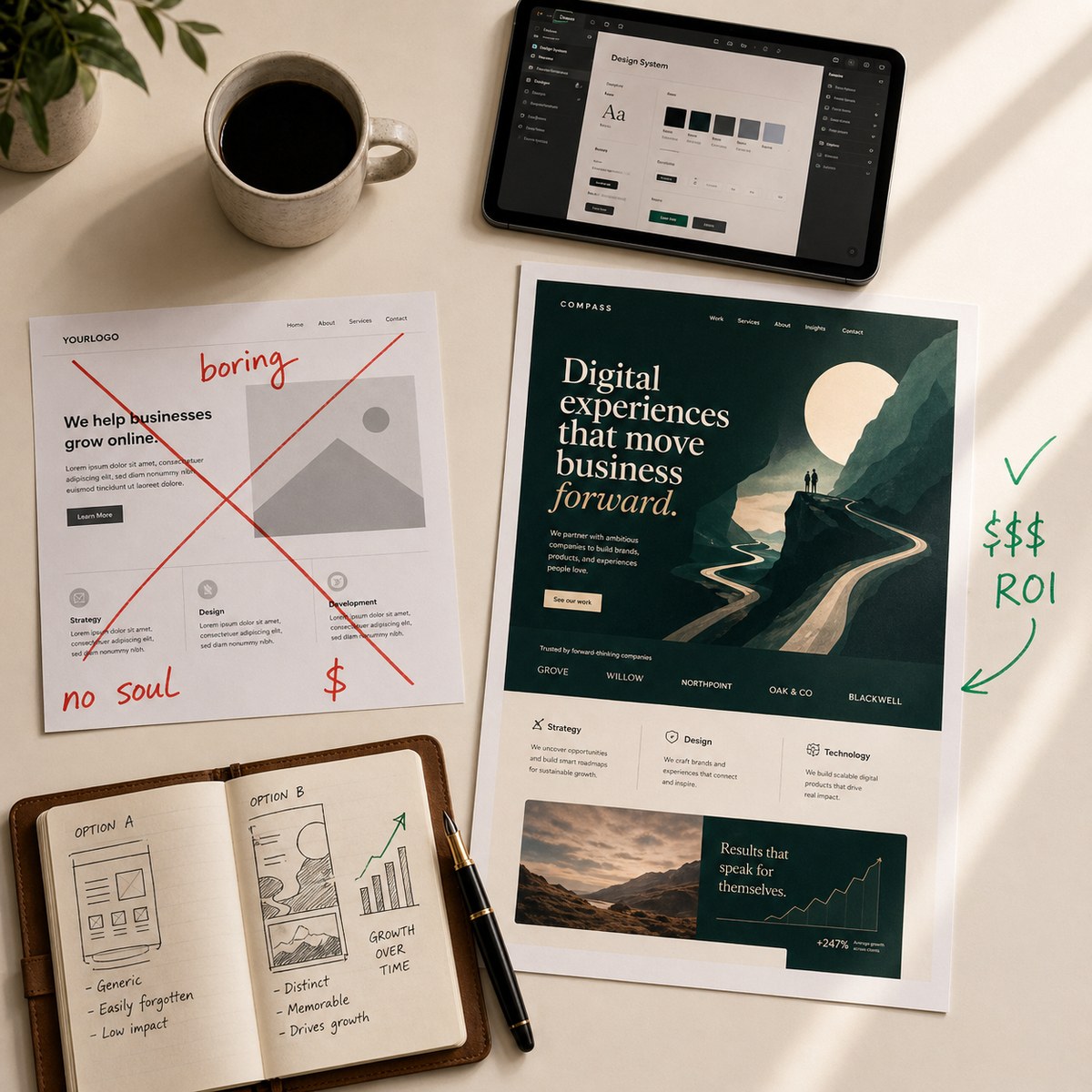
The image on my desk shows two designs side by side. On the left, a templated layout, generic header, stock image, three columns of features. Annotated in red ink: "boring", "no soul", "$".
On the right, a proper digital experience, hero with intent, real photography, brand voice, clear next action. Annotated in green: "✓ $$$ ROI".
The cheap site doesn't just fail to grow your business. It actively costs you trust every visitor who lands and leaves within four seconds.
The three things "just a website" can't do
- Convert visitors into customers. Templates don't know your business. They optimize for general aesthetics, not your specific funnel.
- Build brand equity. A generic site says "we're like everyone else." That's the opposite of brand.
- Scale with you. When you grow, the template becomes a prison. You can't add the features your business actually needs.
What you should build instead
Not "more expensive website." A digital infrastructure that thinks like your business.
For example, when I built Vantage Magazine (an AI-powered intelligence publication), the question wasn't "what does a magazine website look like?" The question was: what infrastructure does an AI-augmented editorial team need? The answer: a Next.js publishing system with multilingual content, AI-assisted research workflows, paywall logic, and SEO optimization built into the architecture from day one. Not a WordPress install with a magazine theme.
The components of "premium digital"
- Custom design system built around your brand's visual language, not a template
- Performance budget that loads in under 2 seconds globally
- Conversion architecture with clear paths to revenue or contact
- Content infrastructure that lets non-technical team members publish without breaking the site
- Analytics integration that measures the things that actually matter to your business
- SEO foundation with semantic HTML, schema markup, sitemaps, done once, paying off for years
How to know what you actually need
If your business runs on:
- Trust (consulting, professional services) → premium digital is required
- Volume (e-commerce, marketplaces) → premium digital pays for itself in conversion uplift
- Subscription (SaaS, content) → premium digital IS the product
- Local presence only (small physical business) → maybe a template is fine, honestly
The line is whether your website is the storefront or the product. If it's the product, "just a website" is malpractice.
The cost equation, revised
A templated website: low upfront cost, high opportunity cost forever.
Premium digital infrastructure: higher upfront cost, compounding returns.
The math is simple. Most founders just don't see it because they only count the upfront line.
Want to figure out what "premium digital" looks like for your specific business? Let's audit what you have and design what you need.